Back to 336th/K-14 Archives Back to Misc. USAF Archives Back to F-100 page F-100D number 56-3141: Then and Now Today, this particular F-100 is likely the sole surviving figher from its original squadron. Below in chronological order are photos, facts and questions about this old bird. |
|

Caption on original photo reads "WJS (William J. Starr) in F-100D, ready to start engines, CAFB (Cannon Air Force Base), New Mexico, 1958." (386th FBS, later redisignated/absorbed into, the 522nd Tactical Fighter Squadron) Who's that seated the jet above? Despite dad's hand-written notation on the photo, I do not think this is dad seated in the jet. Dad often handed his camera to other pilots to snap photos of him in various aircraft. However, in this case I think dad took the photo of a friend seated in that jet, and in a very rare mistake miss-remembered it exactly 20 years later (when he wrote the above note). The evidence is pretty simple: dad was 6 foot 2, and his head protruded above the head rest on the F-100. That's clearly not the case in the above photo.
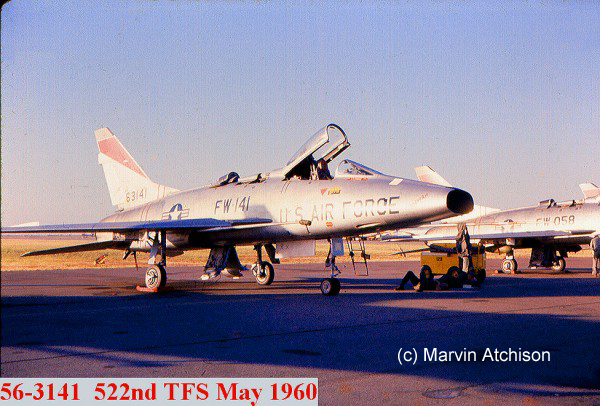
William J. Starr flying F-100 56-3150, in 1957. USAF crew chief Marvin Atchison, who served in this squadron remembers 56-3141 and my father. He said dad was so tall, that he had to lower the seat all the way to the floor, and extend the rudder pedals. He said after dad closed the canopy, dad would run his hands over his head making sure there was headroom! Below is Marvin's photo of F-100D 56-3141 taken about two years after dad's photo of the same jet. The full tail number and red 522nd squadron tail markings are visible in his photo.
This was not was dad's assigned jet. But in his nearly 6 years with the squadron, he likely flew it a time or two. Her original 1950's squadron (386th/522nd) was considered a top F-100 squadron at one time (see below Top Gun trophy photo), deploying to Germany during the Berlin crisis of 1961, and also alerted during th Cuban missle crisis.
F-100D number 56-3141 during in-flight refueling maneuvers, undated photo from my dad's archives, circa late 1950s near Cannon AFB, New Mexico. Again, red markings indicate my father's squadron's colors; either during its original designation as 386th Fighter Bomber Squadron (312th Fighter Bomber Wing) or later 522nd Tactical Fighter Squadron (27th Tactical Fighter Wing). Photo by or of Lt. William J. Starr, USAF. This photo was not likely taken on same flight/day as top of page photo; note lack of wing tanks in this photo, and presence of such in photo at top of page.
In later years the jet flew missions in Vietnam, and later in the Michigan Air National Guard before going to the bone yard in 1979. In the 1980s it was amongst many F-100s converted to FSATs -- full scale aerial targets, remotely controlled target drones, as seen below.
Above and below: F-100 number 56-3141 photographed by Phil Juvet, www.philsaeronauticalstuff.com, in either December 1987 or February 1988 (Phil said this color slide was labeled "Feb 1988" but says it might have been taken in December 1987) at Flight Systems hangar in Mojave, CA, during its conversion and/or maintenance as a remotely controlled target drone.
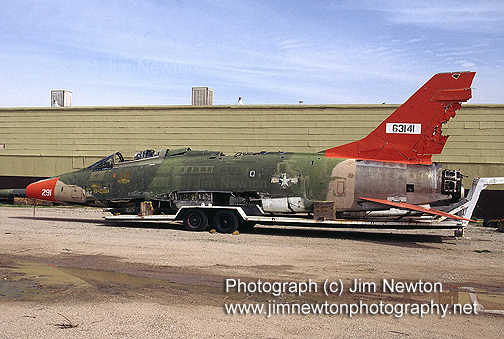
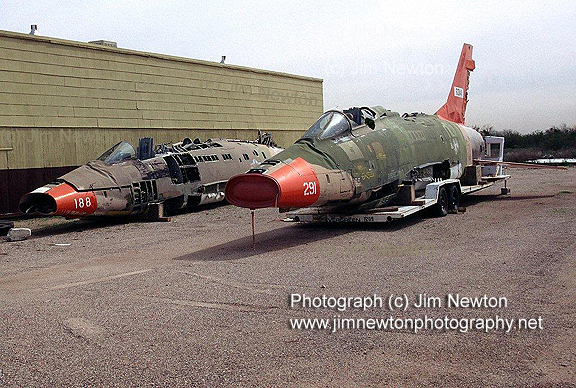
According to multiple online sources, 56-3141 made its last flight from Holloman AFB New Mexico on February 22, 1988 where it sustained damage over White Sands Missile Range by an AIM-120 missile fired from an F-15 fighter jet. The F-100 then made a forced landing at the former Northrup Strip, now known as White Sands Space Harbor. Somewhere in the early 1990s F-100 number 56-3141 ended up in a private collector's hands, an aviation mechanic who worked at the Evergreen facility in Marana, Arizona. I spoke with him in 2010. On owning this nearly destroyed F-100 he told me simply "Back then, if you had an F-100, you had an F-100!" It was an item to have. In 1993 Jim Newton photographed the battered remains of 56-3141 at Marana Airizona's Evergreen commercial aircraft maintenence center. See below photos, courtesy www.JimNewtonPhotography.net . He also took photos of a second F-100 drone survivor at Marana.
Note that both airframes have damaged noses-- the top panels are both crinkled upwards indicating very hard nosed-in landings after their last drone flights.
The F-100D that is likely 56-2992 (on left) was traded several times and is currently stored at a the Carolinas Aviation Museum, in Charlotte N.C. And this webiste shows it in restoration mode there: http://supersabre.com/subweb/FuselagePart04.htm
The day he took these photos Jim Newton identified the F-100 on the left as 56-2992, and that it's drone designation #188 is a match for that F-100. He read the serial number that day on the data panel. That ID can just be made out (below images) below the cockpit in the below close up images.
The serial is on the second line.
Above: F-100D 56-3141, 1993, Marana, AZ. The data block/panel below the forward canopy is only partly visible due to painting over or repair or replacement. Maybe the panel or this entire section of the airframe was repaired or replaced at some point --likely during its drone service life. F-100D number 56-3141 Today... Below: F-100D number 56-3141, in 2010 at the Planes of Fame museum in Chino, California. The man who owned the jet at Marana told me he traded it to the museum for a working kit plane. The day I took these photos, the museum founder Jim Maloney told me he had briefly considered restoring the jet to a more complete display, but decided it made a more interesting display in its last known shot-up state. Mr. Maloney did have a museum volunteer replace/repair the crinkled upper nose section (seen below in primer paint).
F-100D 56-3141, April 2010, Chino, CA Above: One less elevator! The consistency of the damage pattern suggest this tail section is largely an original tail/aft section. Mr. Maloney said they once considered putting another aft section on it from a less damaged F-100, but in the end he preferred to showcase the original tail damage incurred by the air-to-air missle strike. On the same day I spoke with Mr. Maloney, (during the Chino air show 2010) another museum volunteer told me that most visitors see the tail damage and assume this jet was used as a ground target, and that no jet could fly like that. But he assured me that it was an aerial hit that blew away a horizontal stabilizer, and that the plane flew another 45 minutes after the missle strike to land via remote control.
As to the integrity and authenticity of the airframe today: Early web references, mainly by aviation photographers, noted this display jet was a composite of 56-3141 and F-100 number 56-2992. But in 2010 the original (post-drone recovery) owners of these two aircraft, located at the Evergreen Maintenence facility, told me at least they never mixed the two aircraft together, and merely traded the better of the two (56-3141) to the Planes of Fame Museum in Chino for two light civilian aircraft. Regardless, considering the extensive upgrades and maintenence given to F-100s over their service lives, and likely parts-swapping during their short, turbulent lives as target drones, I suspect little of 56-3141's original 1950s parts surive on the display at China Planes of Fame Museum.
The tail of 63141 as it appears today.
This green part looks like a portion some other salvaged F-100, likely from 992.
Wing flaps-- one thing that set the D models apart from the C models, I believe. And those big, finned pods on the wings are aux fuel tanks, and not likely original. As technology evolved, and wear and tear took its toll, certain components would be replaced and exchanged over the years, like tanks, instruments, ejection seats, and even the engine itself.
This shiny tail portion is the titanium afterburner section.
This looks like a wheel chock from 992 got mixed into the trade, although I suspect maybe even a landing gear component may have found its way here. One of the original owners told me 141 broke something on its landing gear on its last landing.
The 1993 Arizona facility photos shows this name plate missing. This one is either a replacement, or it was just removed for a while during transport. I wonder how many pilots had their name stenciled over through the years on these old birds? The last one looks like "Bo" Tadner. Mr. Maloney at the Chino Museum said he understood this bird served two tours in Vietnam. Records from amarcexperience.com show that 56-3141's last days on active duty were with the Michigan Air National Guard. It was retired to the Davis-Monthan "boneyard" in 1979, then turned into a target drone, otherwise known as a "Full Scale Aerial Target" (FSAT). Coincidentally one week before my 2010 wedding, former 522nd Crew Chief Marvin Atchison alerted me to its existence at Chino. Click here to read about the F-100 drone story. (off site reading from Joe Baugher's website) |
|
|
|